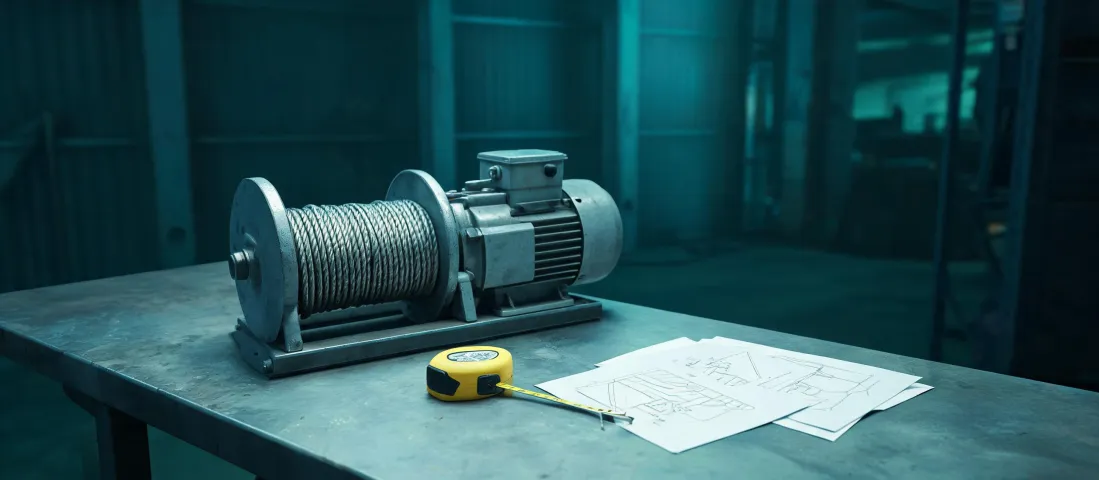
A maintenance tech on a US loading dock stands with the pendant of a StrongArm AC electric winch in one hand and a cart of pallets at the far end of an almost straight cable. The cable is taut. What decides whether this pull is safe is not the tension in the line. It is how much cable is still wrapped on the drum, and what is going to hold the cart once the motor stops.
Scope first. The limits below come from the manufacturer's manual for the StrongArm cited AC family, and they belong to that family rather than to every AC electric winch on the market. A different model comes with its own manual, its own minimum turns and its own tie-down language, and that documentation wins. The claim itself is narrow enough to state in one line: drum wraps anchor the cable, and separate straps or chains hold the load.
A Taut Cable Can Still Be the Wrong Setup
A taut cable looks ready and isn't. Looks tight, still a dud: it tells you that something is pulling, not that the drum has anything to hold with. The load gets from the hook into the drum through the wraps stacked on the reel, each wrap pressing against the ones beneath it and against the drum surface, so the pull is carried by friction spread across several wraps instead of by the fitting at the end of the line. Fewer wraps means less contact area, and less contact area means less of the load gets handed to the drum. Run the cable out almost flat and the pull lands on the terminal, the one part of the assembly that was never meant to carry a working load.
That is why the manual is blunt: never apply load to the winch with the cable fully extended, and keep at least three turns of cable on the reel. Three is the floor for this family, not a target to beat.
The pre-pull check comes down to one number, and counting it takes about as long as reading a label. With the hook at the point where the pull will start, look at the drum from the side and count the wraps that will still be on the reel when the cable comes under tension, meaning the ones staying put rather than the ones about to spool off. Fewer than three, and the cable goes back on the drum before anything takes load.
Check Turns, Pull, Then Tie Off
The working order on a dock is four steps: turns, clearance, pull, tie-off. Before the load is attached, confirm the three wraps. Next, clear the winching area of anyone who is not needed for the pull. The manual puts that as keeping the area free of all unnecessary personnel, and it is a decision made before the motor runs rather than a warning shouted during it. Take your position off the line of pull, and make the pull.
The step that gets skipped is the last one. When the winching operation is complete, do not depend on the winch to support the load; secure it properly with tie-down straps or chains. The reason pulling and holding are different jobs is that pulling uses the motor, the gear train and the brake while an operator stands there with the pendant in hand. Holding has to survive the operator walking away, the pendant being set down, and the circuit being shut off at the end of the shift. The manual draws that line by moving the load off the winch right after the pull, while the hook is still easy to reach.
Where Hands and Load Position Matter
Two habits cover the hand risk. Keep hands and fingers clear of the drum and cable area while the winch is operating, and do not guide the cable by hand as it rewinds onto the drum. The reason is mechanical: a rewinding drum draws cable in at line speed and forms a pinch zone along the whole wrap, and a tensioned cable stores energy that releases the moment it slips or the load shifts. A hand inside that zone has nowhere to go. A cable spooling badly is a stop-and-respool problem, not something to correct with fingers.
Body position follows the same physics. Never stand between the load and the winch. If the cable, the hook or the attachment lets go, the stored energy drives the line back along the line of pull, and the space between the load and the drum is where it arrives. Standing off to the side is the difference between watching a failure and being inside one. Which means the spot you choose before the first inch of travel belongs on the same checklist as the turn count.
How to Confirm the Load Is Held
Confirmation after the pull is a physical check, not a feeling that the cart looks settled. Walk to the load and find the restraint doing the holding, tie-down straps or chains, and make sure the load is on that restraint rather than on the winch. If the only thing between the cart and the floor is the winch, the job is not finished. The winch is a puller, not a parking brake.
Think about what is actually holding the load in that state: a motor at rest under load, a brake, and a gear train, borrowed for a holding job they were not chosen for. Lose the power, or have the brake fail to hold, and the holding job falls back on the winch. A tied-off load does not depend on any of that. Which is why the manual's instruction is flat and unconditional, always secure the load properly, and why the tie-off is the confirmation step rather than an optional extra once the pulling is done.
Inspect the Cable Before the Next Pull
Turns and tie-offs only work on a cable that is fit to pull. Before the next job, inspect the cable along the length you can reach and check for kinks, frays or abnormal stiffness; the manual says replace at the first sign of that kind of damage. A kink is a permanently deformed section that no longer shares load evenly with its neighbors, and a fray is broken wire or fiber, so both concentrate stress at the point where the cable is already weakest. The first sign is the trigger, not the next scheduled maintenance window.
Periodic lubrication with a light oil improves cable life, which is the cheap half of the routine. The other half costs a schedule slot, because replacing the cable on this model means removing the clutch handle, its two screws, along with the four cover mounting bolts before the cable comes free. That is planned downtime, not a swap squeezed in at the end of a shift, and it is why a quick look at the cable belongs before the pull rather than after the failure.
Here is the trade you are making. Counting wraps, clearing the area and tying off take time that is not spent pulling, and on a busy dock an extra few minutes per move is a real cost paid on every move. What comes back is a load path that does not depend on a powered device staying powered, and a cable that gets looked at often enough to be replaced before it fails under load. If the cable already shows a kink, a fray or a stiffness that was not there last month, the trade flips, and the replacement happens before the next pull instead of after it.
