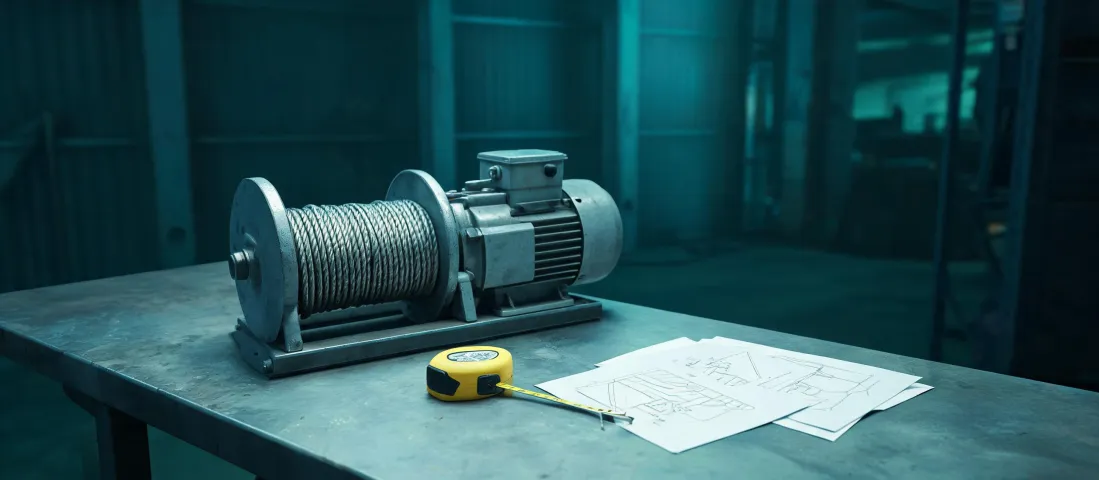
Double line on the StrongArm SA7000AC, SA7015AC, SA12000AC and SA12015AC means running the cable out through the factory-supplied pulley block and hook, then bringing the hook end back to an eyehook mounted on the winch stand close to the base of the winch. The condition that gets skipped: that eyehook has to be strong enough to take loads beyond the winch's single-line rating, and the motor's 3-minute continuous run limit does not go away just because two cable runs are sharing the load.
What Double Line Actually Buys You
These four models ship with the parts already in the box: a pulley block and hook plus 50 ft of cable, set up for double-line operation. Nothing extra has to be sourced to change the rigging. The change is in how the cable is routed, not in what the winch is.
Run the cable out to the pulley block at the load and bring it back. What the drum pulls against is now two cable runs instead of one, with the load hanging on the block between them. Two runs share the same load, so each run carries roughly half the tension a single run would, and the drum sees that reduced tension. The reason double line pulls more is load sharing, not a different motor or a different drum. Which means the hardware you already bolted down can move a load it would stall on single line, at lower line speed and with more cable consumed.
That gain holds only with the block in the line. Wrapping the cable around a structural member or an unrated shackle changes the geometry without giving you a rated pulley, and the double-line figures are written around the factory block.
Anchor the Stationary Hook Before You Run Cable
The stationary end needs a home. Install an eyehook on the winch stand close to the base of the winch and clip the stationary cable hook to it. The position is not cosmetic: an anchor low and close to the base keeps the load path short and keeps the stand resisting the pull instead of being tipped by a lever arm measured up the stand.
Strength is the part that decides whether the rig holds. The eyehook must be strong enough to withstand loads in excess of the single-line rating of the winch, not equal to it. That reads backward until you follow the load path. The drum is pulling with less force than it would single line, and the eyehook still has to be rated above the winch's single-line figure. Which means the anchor, not the winch, is what decides whether a heavy pull ends with the load moved or with hardware on the floor.
Before anything gets drilled, put the eyehook's rating next to the winch's rating and make the comparison on paper. If the anchor's number is the smaller one, the rig has a weak link and the pulley block has bought you nothing.
Mounting the Base and Rechecking the Anchor
These winches have keyhole slots in the base for use with quick mounting shoulder studs, if that suits how the unit gets used. Quick mounting earns its place on a unit that comes off the stand for other jobs or for storage. It also changes what you have to look at before a heavy double-line pull.
The eyehook and the winch base sit on the same stand and take load at the same time. If the base can shift in its slots under load, the anchor shifts with it, and two runs that were lined up no longer are. So mounting security is part of the rigging, not a separate install step you finish on another day. After mounting, check the base-to-stand contact and check where the eyehook sits relative to the base, both before the cable goes on.
Mounting hardware for a given stand is not spelled out in the manual pages this article draws on. That is a question for the model manual and for whoever rated the stand, and it is worth settling before the first pull rather than after.
Why a 25-Foot Pull Reels 50 Feet
With double line, a pull of 25 ft requires reeling in 50 ft of cable. That ratio comes straight out of the geometry, not out of anything unusual about these models. Two cable runs span the same distance the load travels, so the drum has to take up twice the load's travel. Which means every foot the load moves costs two feet of cable, and the 50 ft on the drum sets a practical ceiling of about 25 ft of double-line travel.
That ceiling is where most rigging plans go wrong. People size the pull by the load and forget to size it by the travel. A 30 ft pull that was easy single line does not fit this configuration at all, and the obstacle is not capacity. It is cable length.
Measure the intended travel before the cable goes on, double it, and hold that number against what is actually spooled. If the doubled figure is bigger than the cable on the drum, the pull does not fit and no amount of careful operating fixes it. Shorten the travel, reposition the load, or stay single line and accept the lower capacity.
The 3-Minute Run Limit and Cooling Between Pulls
Motor cooling periods must be allowed for longer pulls. Maximum continuous run time is 3 minutes, and continuous running in excess of 3 minutes will damage the winch motor. Note where that limit lives: on the motor, not on the cable.
The same geometry that eats cable eats run time: the drum has to turn for every foot of the doubled line, so it works longer to move the load the same distance. Less force on the drum does not mean less motor time. Which means the shared load buys capacity and pays for it in run time, so the pull gets broken into segments under the limit, with cooling between them, instead of run straight through.
That is a trade we take every time on a heavy pull. We would rather spend an extra few minutes with the winch sitting idle while the motor cools than find out what a cooked motor costs in a live aisle, because the downtime costs more than the wait ever will.
Double line is not a free upgrade. It is a slower one, and the cooling time is part of the price of the extra capacity, not an inconvenience bolted onto it.
When Double Line Is the Wrong Choice
The published ratings are based on a 10 ft pull, and the winch is for intermittent use only. A long, continuous double-line haul sits outside what those numbers describe, not because the winch is weak, but because the rating and the duty cycle were never written for that job.
Double line wins on short, heavy pulls and loses on long, fast ones. The capacity gain arrives with double the cable travel and more heat per foot of load movement, so the decision comes down to travel length and duty cycle, not to the load alone. A crew that picks double line because the load is heavy, without checking how far that load has to move, has picked the wrong tool for the right reason.
Staying single line is not a failure. It is the right call when the travel is long, the pull has to be continuous, or the cable on the drum will not cover the doubled distance, and the price of that call is capacity you may not have. That is why the decision belongs in planning, before the block goes on, and not in the aisle with the load hanging.
Suppose a heavy load in a warehouse aisle will not move on single line. The rig that finishes the job has an eyehook through the stand near the base, a pulley block on the load, and a crew that knows 50 ft of cable buys only 25 ft of travel. They measure both, anchor the eyehook to a rating above the single-line figure, and split the pull into segments with cooling between them, and the winch goes back in service. The crew that rigs the block and starts pulling gets a hot motor and a line that has to stop. Double line is worth rigging when the anchor and the cooling plan are both settled before the first pull. Otherwise it is a more expensive way to stall.
